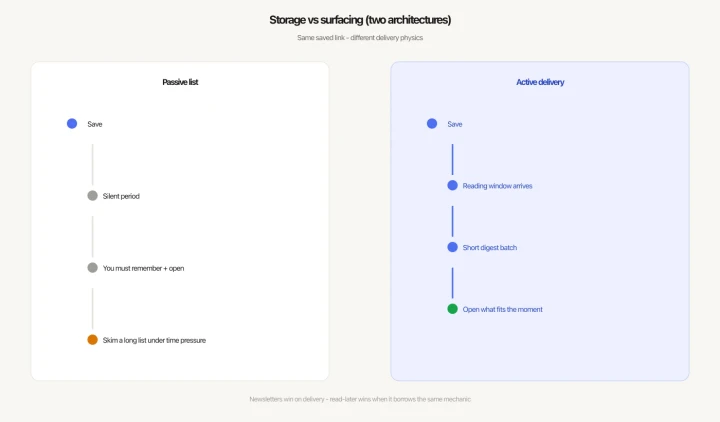
When Pocket or Instapaper describes what they do, they use the word "save." Save for later. Save to read later. Save articles. The product metaphor is storage.
Storage is the wrong model for what most people actually need. The problem isn't that links disappear — browser bookmarks have solved that for 30 years. The problem is that saved links don't come back to you at the right time. The problem is surfacing.


Why the moment of saving is the worst time to read
Content gets saved during moments of passive browsing: on the train, waiting in a queue, during the dead time between meetings. These are moments of low attention and no real reading intent. You're not saving because you're ready to read. You're saving because you saw something interesting and don't want to lose it.
The reading context — when you're focused, have time, and want to engage with something — arrives later and separately. The article is in a list somewhere. The list is not in front of you. The connection between the moment of curiosity and the moment of capacity rarely gets made.
This is context collapse: the context in which you saved the article (distracted, rushed, low attention) isn't preserved anywhere that would help surface it in the context you need (focused, available, ready).
Why scrolling a list doesn't recover the context
You saved 12 articles last week. Today you open Pocket, scroll the list, and see: "Understanding Interest Rate Risk," "The UX of Trust," "A Brief History of Cargo Pants," "Why Remote Work Fails at Scale."
You're trying to choose which of these to read right now, with no information about why you saved each one, in what frame of mind, or what made it feel relevant at that moment. You know your attention window is about 20 minutes before a meeting starts.
Most people in this situation either open nothing (the list feels overwhelming) or open something random (the first or last item on the list). Neither behavior builds a reading habit.
Why email newsletters get read
Email newsletters have a completion rate of 30–50% for audiences who voluntarily subscribe. Saved Pocket articles have a completion rate roughly estimated at under 10%. The content quality isn't the differentiator — newsletters contain plenty of articles you'd also find in Pocket.
The difference is delivery. A newsletter arrives on a schedule, in a specific channel (email), with a subject line that gives you enough context to decide in one second whether you want to engage. The context isn't collapsed — it's maintained by the delivery mechanism.
You don't have to remember the newsletter exists. It finds you.



What a surfacing mechanism requires
For saved content to be surfaced effectively, three things need to be true:
- Timing. Content must arrive when the user has reading capacity, not at random or only when manually triggered. For most people, this means one or two predictable slots per day.
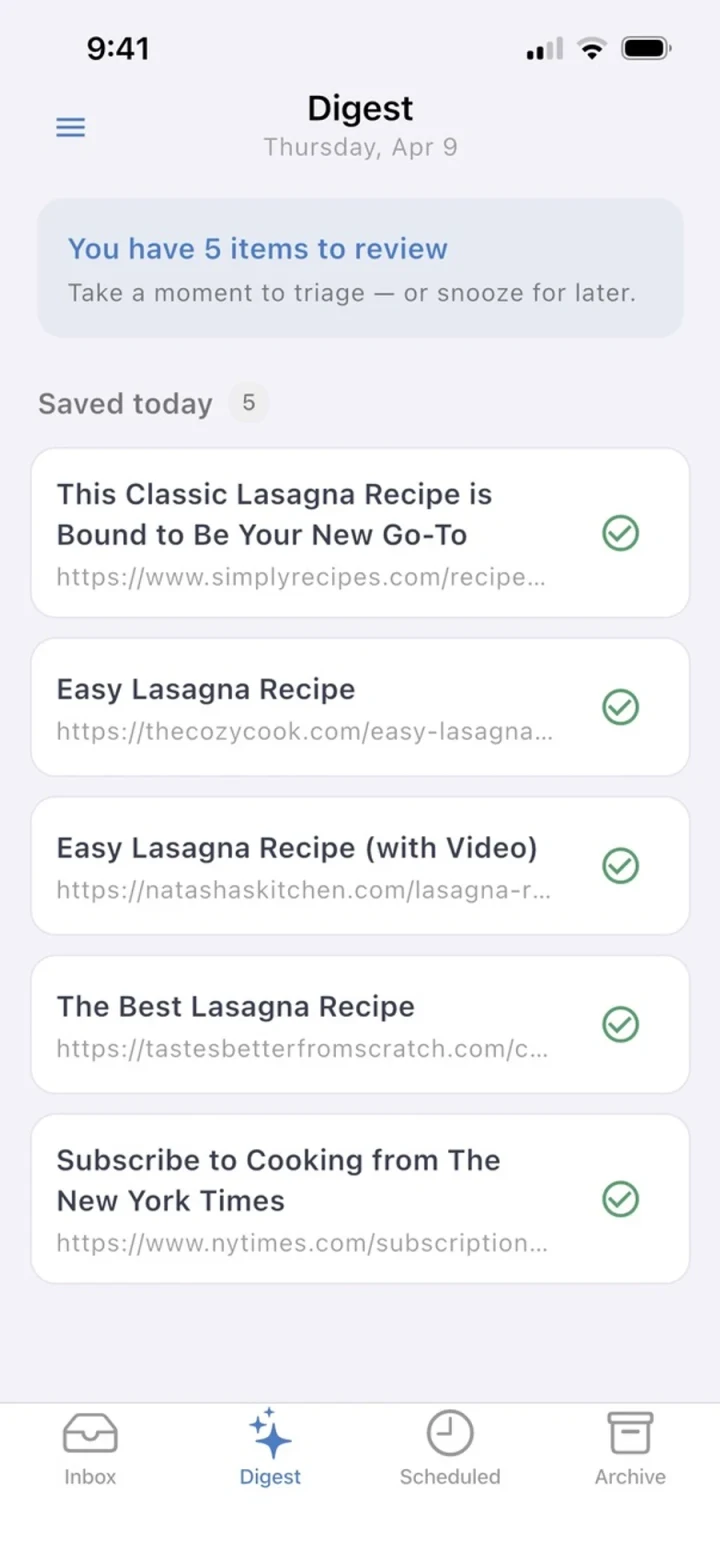
- Volume control. A surfaced list should be short enough to process in the available time. A 40-item notification defeats itself. Three to five items that can each be evaluated in five seconds is workable.
- Active delivery. The content must arrive without requiring the user to initiate retrieval. Push beats pull for habits that haven't yet been formed.
This is the architecture of a daily digest. It's not a new idea — it's the architecture of every successful email newsletter. What's new is applying it to arbitrary saved links rather than subscribed content.
Why switching apps doesn't fix this
Pocket users switch to Instapaper hoping the cleaner reading view will make them read more. Instapaper users switch to Matter hoping the newsletter integration will consolidate their reading. Neither move addresses the surfacing mechanism.
If you moved your entire Pocket library to any other passive-list app, the read rate wouldn't change. The architecture of passive storage + voluntary retrieval produces the same outcome regardless of which app implements it.
The only way to get a different result is to change the model: from passive storage to active delivery.
Refloat's approach
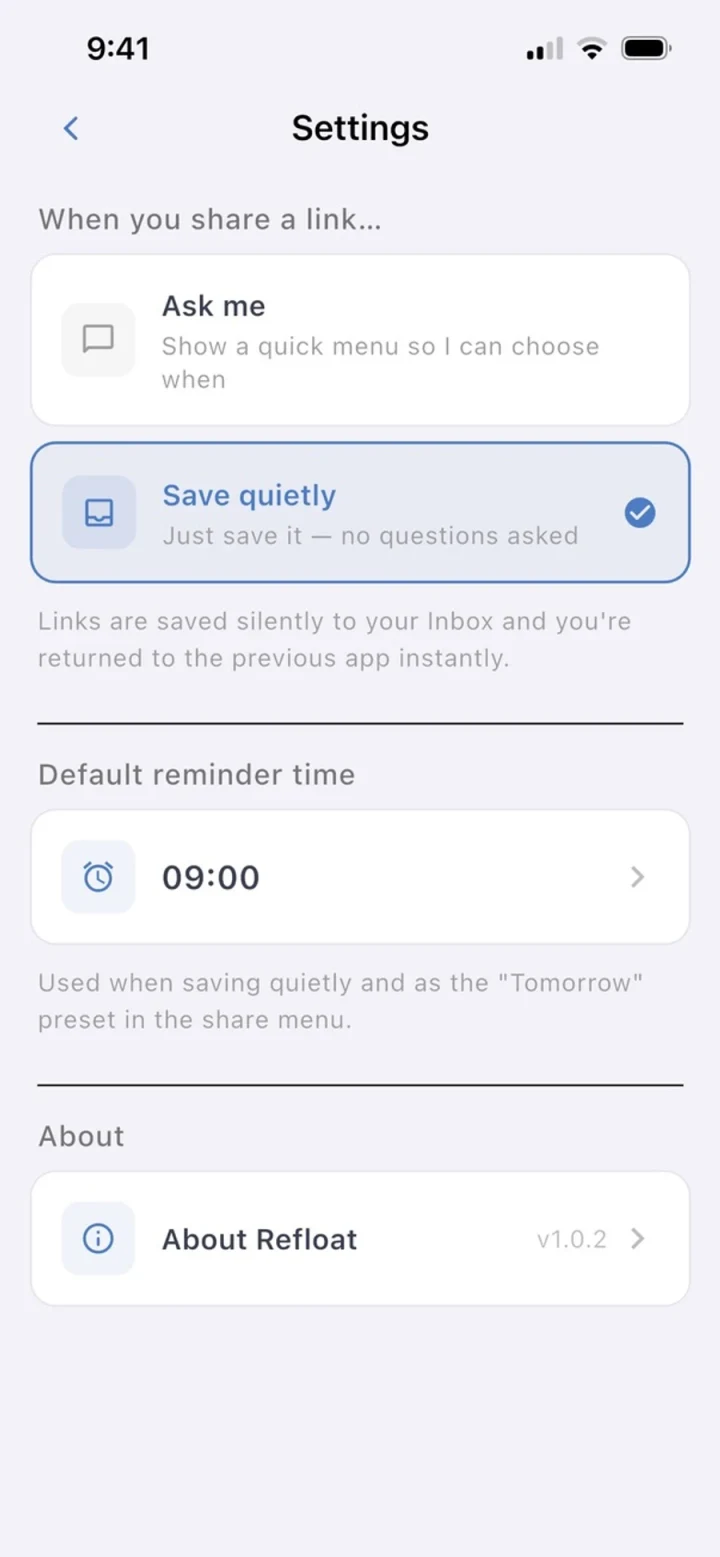
Refloat implements active delivery for saved links. You define a reading window — a daily time range when you're available and willing to read — and the app delivers a digest of your saves at the start of that window. Nothing needs to be remembered or retrieved.
The saving flow is fast by design (under three seconds, no account required) because the surfacing problem is harder to solve than the saving problem. The value isn't in the archive — it's in the delivery.