
Cal Newport's 2019 book Digital Minimalism made a specific argument: the costs of digital tools are often invisible until you step back and audit whether they're actually serving your goals. Newport wasn't saying delete everything. He was saying be deliberate. Use tools that genuinely add value, at rates and in ways you've consciously chosen.
The read-later habit is interesting when you apply this lens. Saving links looks, on the surface, like the intentional behavior digital minimalism recommends: you saw something worth returning to, and you filed it for later rather than giving it your attention immediately. The problem is that "later" rarely arrives in the form you imagined.
The reflexive save
There are two kinds of saves. The first is deliberate: you read a headline, you're genuinely interested, and you want to return to it. The second is reflexive: you save because the option is there and the headline is vaguely relevant and it takes one tap. You don't particularly want to read it. You want to feel like you're keeping up.
Most backlogs are built mostly on reflexive saves. The genuinely interesting articles you save with real intention represent maybe 20% of what goes in. The rest is optimism and friction avoidance.
Digital minimalism applied to saving would say: pause before saving. Ask whether this article is actually worth your future time. Save only what you'd genuinely read if it appeared in your reading window tomorrow.


The case against "save less"
The counter-argument has merit. Saving is cheap, and the cost of losing a link you actually wanted is real. If you've ever thought "I saw an article about this last week, where did I put it" and come up empty, you know the cost.
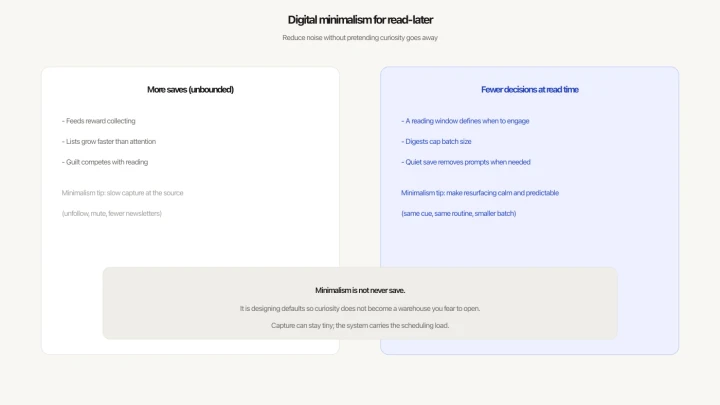
The real problem isn't volume of saves. It's the absence of a mechanism that brings good saves back to the surface. A well-curated backlog of 50 articles is no better than a poorly-curated one of 500 if neither one resurfaces the content at a useful time.
Reducing the save rate fixes the symptom. Fixing the surfacing mechanism fixes the underlying problem.
What intentional saving actually looks like
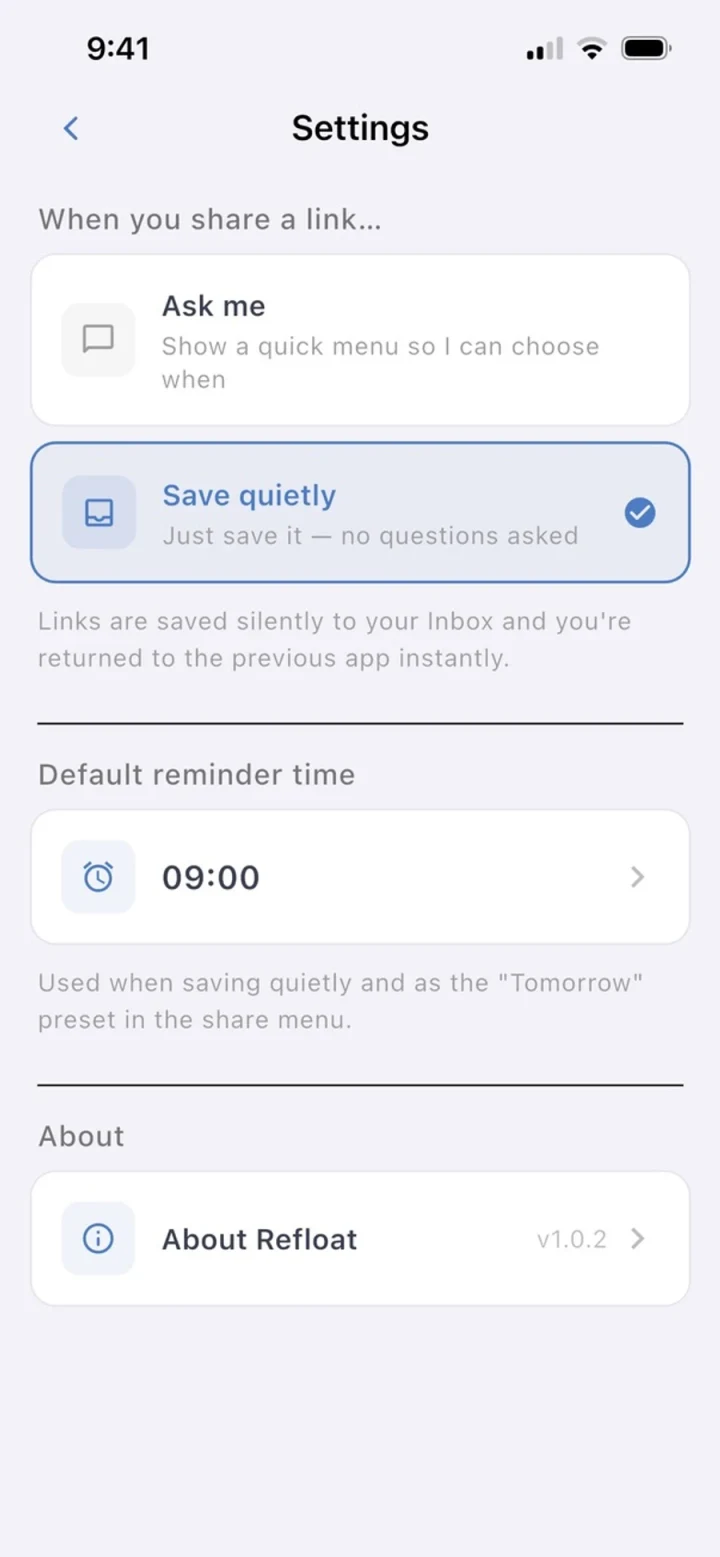
Intentional saving isn't necessarily saving less. It's saving with context. When you save something and attach a time to it — "I want this tonight" or "this is for the weekend" — you're making a more specific commitment than "save for later."
That specificity changes the relationship between saving and reading. The article isn't going into a general queue. It's going into a slot you've already mentally allocated. That's a much more honest account of your actual intentions.




The reading window as a minimalist practice
Defining a reading window is itself a minimalist act. You're saying: this is the time I've chosen to consume saved content. Outside this window, no notifications, no pressure to open an app, no list to feel guilty about. The practice is bounded.
This is how Refloat implements it. You set a daily time range once. Outside that window, saved links wait quietly. During the window, a digest arrives. You open what interests you, skip what doesn't, and close the app. The reading practice has a clear start and end.
Compare this to the alternative: an ever-present reading list that you could check at any moment, creating a low-level background obligation that never quite resolves. That model — always accessible, never finished — is the opposite of minimalist.
Less overwhelm, not fewer saves
The goal of digital minimalism isn't an empty read-later app. It's reading more of what you actually wanted to read, and feeling less overwhelmed by the gap between what you've saved and what you've read.
The three things that close that gap: save only when you mean it, attach a time context to each save, and use a system that surfaces your saves during the time you've committed to them.
That's a achievable with a small change to how saving works — not with a purge of your bookmarks or a resolution to consume less.